La Llorona by Rudolfo Anaya Read Online
| Gloria Evangelina Anzaldúa | |
|---|---|
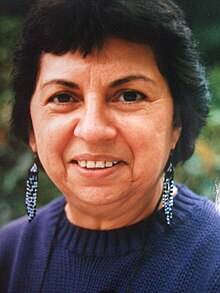 Gloria Evangelina Anzaldúa (1990) | |
| Built-in | Gloria Evangelina Anzaldúa (1942-09-26)September 26, 1942 Harlingen, Texas |
| Died | May xv, 2004(2004-05-15) (aged 61) Santa Cruz, California, U.s. |
| Nationality | American |
| Educational activity |
|
| Occupation |
|
| Signature | |
 | |
Gloria Evangelina Anzaldúa (September 26, 1942 – May 15, 2004) was an American scholar of Chicana cultural theory, feminist theory, and queer theory. She loosely based her best-known book, Borderlands/La Frontera: The New Mestiza, on her life growing up on the Mexico–Texas border and incorporated her lifelong experiences of social and cultural marginalization into her work. She besides developed theories nigh the marginal, in-betwixt, and mixed cultures that develop along borders, including on the concepts of Nepantla, Coyoxaulqui imperative, new tribalism, and spiritual activism.[one] [two]
Early life and pedagogy [edit]
Anzaldúa was born in the Rio Grande Valley of due south Texas on September 26, 1942, to Urbano Anzaldúa and Amalia Anzaldúa née García, oldest of four children. Gloria Anzaldúa's neat-grandfather, Urbano Sr., one time a precinct judge in Hidalgo County, was the first owner of the Jesús María Ranch on which she was born. Her mother grew upward on an adjoining ranch, Los Vergeles ("the gardens"), which was endemic past her family, and she met and married Urbano Anzaldúa when both were very young. Anzaldúa was a descendant of many of the prominent Spanish explorers and settlers to come to the Americas in the sixteenth and seventeenth centuries and also had indigenous ancestry. The surname Anzaldúa is of Basque origin. Her paternal grandmother was of Spanish and German ancestry, descending from some of the earliest settlers of the South Texas range country.[3] She has described her begetter's family as being "very poor aristocracy, only aristocracy anyway" and her female parent as "very india, working course, with perchance some blackness claret which is ever looked downwards on in the valley where I come from." She likewise believed she had Jewish beginnings because of her father who had "very Jewish features, curly hair, the olfactory organ."[4]
Anzaldúa has written that her family gradually lost their wealth and condition over the years, eventually being reduced to poverty and being forced into migrant labor, something her family unit resented because "[t]o work in the fields is the lowest job, and to be a migrant worker is even lower." Her father was a tenant farmer and sharecropper who kept 60% of what he earned, while 40% went to a white-owned corporation called Rio Farms, Inc. Anzaldúa has claimed that her family lost their land due to a combination of "taxes and dingy manipulation" from white people who were buying up country in South Texas through "trickery", and from the behavior of her "very irresponsible grandpa" who lost "a lot of state and money through carelessness." Anzaldúa was left with an inheritance of "a petty piece" of twelve acres, which she deeded over to her mother Amalia. Her maternal grandmother Ramona Dávila had amassed state grants from the time Texas was office of Mexico, but the land was lost due to "abandon, through white peoples' greed, and my grandmother not knowing English."[4]
Anzaldúa wrote that she did non phone call herself an "republic of india", only still claimed Indigenous beginnings. In "Speaking across the Carve up" from the Gloria Eastward. Anzaldúa Reader, she states that her white/mestiza grandmother described her every bit "pura indita" due to dark spots on her buttocks. Later, Anzaldúa wrote that she "recognized myself in the faces of the braceros that worked for my father. Los braceros were generally indios from fundamental United mexican states who came to work the fields in south Texas. I recognized the Indian aspect of mexicanos by the stories my grandmothers told and by the foods we ate." Despite her family not identifying every bit Mexican, Anzaldúa believed that "nosotros were still Mexican and that all Mexicans are part Indian." Although Anzaldúa has been criticized past Indigenous scholars for allegedly appropriating Indigenous identity, Anzaldúa claimed that her Indigenous critics had "misread or has not read enough of my work." Despite claiming to be "3 quarters Indian", she likewise wrote that she was afraid she was "violating Indian cultural boundaries" and afraid that her theories could "unwittingly contribute to the misappropriation of Native cultures" and of "people who live in existent Indian bodies." She wrote that while worried that "mestizaje and a new tribalism" could "detribalize" Indigenous peoples, she believed the dialogue was imperative "no thing how risky." Writing about the "Color of Violence" conference organized by Andrea Smith in Santa Cruz, Anzaldúa accused Native American women of engaging in "a lot of finger pointing" because they had argued that non-Indigenous Chicanas use of Indigenous identity is a "continuation of the abuse of native spirituality and the Internet cribbing of Indian symbols, rituals, vision quests, and spiritual healing practices similar shamanism."[five] [vi]
When she was eleven, her family unit relocated to Hargill, Texas.[7] She graduated equally valedictorian of Edinburg High School in 1962.[viii]
Anzaldúa managed to pursue a university education, despite the racism, sexism and other forms of oppression she experienced equally a seventh generation Tejana and Chicana. In 1968, she received a B.A. in English, Art, and Secondary Education from University of Texas–Pan American, and an Yard.A. in English language and Instruction from the University of Texas at Austin. While in Austin, she joined politically agile cultural poets and radical dramatists such as Ricardo Sanchez, and Hedwig Gorski.
Career and major works [edit]
After obtaining a Available of Arts in English from the Pan American University (at present Academy of Texas Rio Grande Valley), Anzaldúa worked as a preschool and special education teacher. In 1977, she moved to California, where she supported herself through her writing, lectures, and occasional teaching stints near feminism, Chicano studies, and creative writing at San Francisco State Academy, the University of California, Santa Cruz, Florida Atlantic University, and other universities.
She is perhaps most famous for co-editing This Bridge Called My Back: Writings past Radical Women of Colour (1981) with Cherríe Moraga, editing Making Face, Making Soul/Haciendo Caras: Artistic and Critical Perspectives past Women of Colour (1990), and co-editing This Bridge We Call Domicile: Radical Visions for Transformation (2002). She also wrote the semi-autobiographical Borderlands/La Frontera: The New Mestiza (1987). At the time of her death she was shut to completing the book manuscript, Light in the Night/Luz en lo Oscuro: Rewriting Identity, Spirituality, Reality, which she also planned to submit every bit her dissertation. Information technology has now been published posthumously by Duke University Printing (2015). Her children'southward books include Prietita Has a Friend (1991), Friends from the Other Side — Amigos del Otro Lado (1993), and Prietita y La Llorona (1996). She has also authored many fictional and poetic works.
She made contributions to fields of feminism, cultural theory/Chicana, and queer theory.[9] Her essays are considered foundational texts in the bourgeoning field of Latinx philosophy.[10] [eleven] [12]
Anzaldúa wrote a speech chosen "Speaking in Tongues: A Alphabetic character to Third World Women Writers" focusing on the shift towards an equal and just gender representation in literature but away from racial and cultural issues because of the rise of female writers and theorists. She also stressed in her essay the ability of writing to create a world that would recoup for what the real world does not offering.[xiii]
This Bridge Called My Dorsum [edit]
Anzaldúa's essay '"La Prieta" deals with her manifestation of thoughts and horrors that take constituted her life in Texas. Anzaldúa identifies herself every bit an entity without a figurative home and/or peoples to completely relate to. To supplement this deficiency, Anzaldúa created her own sanctuary, Mundo Zurdo, whereby her personality transcends the norm-based lines of relating to a certain group. Instead, in her Mundo Zurdo, she is like a "Shiva, a many-armed and legged trunk with one foot on brown soil, one on white, one in direct society, one in the gay world, the man's world, the women'southward, ane limb in the literary globe, another in the working form, the socialist, and the occult worlds".[xiv] The passage describes the identity battles which the author had to engage in throughout her life. Since early childhood, Anzaldúa has had to deal with the claiming of existence a woman of color. From the beginnings she was exposed to her own people, to her own family unit'south racism and "fearfulness of women and sexuality".[15] Her family unit's internalized racism immediately cast her as the "other" because of their bias that being white and blanched means prestige and royalty, when color subjects 1 to beingness almost the scum of society (merely as her mother had complained nearly her prieta dating a mojado from Peru). The household she grew upwards in was one in which the male figure was the authoritarian caput, while the female, the mother, was stuck in all the biases of this paradigm. Although this is the difficult position in which white, patriarchal lodge has bandage women of colour, gays and lesbians, she does non brand them out to exist the archenemy, considering she believes that "casting stones is not the solution"[sixteen] and that racism and sexism do not come up from only whites merely also people of colour. Throughout her life, the inner racism and sexism from her childhood would haunt her, equally she frequently was asked to choose her loyalties, whether it be to women, to people of color, or to gays/lesbians. Her analogy to Shiva is well-fitted, as she decides to go against these conventions and enter her own world: Mundo Zurdo, which allows the self to go deeper, to transcend the lines of convention and, at the same fourth dimension, to recreate the self and the club. This is for Anzaldúa a form of religion, one that allows the self to deal with the injustices that society throws at it and to come up out a better person, a more reasonable person.
An entry in the volume titled "Speaking In Tongues: A Letter To Third Globe Women Writers", spotlights the dangers Anzaldúa considers women writers of colour deal with, and these dangers are rooted in a lack of privileges. She talks about the transformation of writing styles and how we are taught not to air our truths. Folks are outcast as a result of speaking and writing with their native tongues. Anzaldúa wants more women writers of color to be visible and exist well represented in text. Her essay compels us to write with compassion and with love. For writing is a grade of gaining ability by speaking our truths, and it is seen every bit a way to decolonize, to resist, and to unite women of color collectively within the feminist movement.
Borderlands/La Frontera: The New Mestiza [edit]
She is highly known for this semi-autobiographical book, which discusses her life growing up on the Mexico–Texas border. It was selected as ane of the 38 all-time books of 1987 by Library Journal. Borderlands examines the condition of women in Chicano and Latino culture. Anzaldúa discusses several critical bug related to Chicana experiences: heteronormativity, colonialism, and male dominance. She gives a very personal business relationship of the oppression of Chicana lesbians and talks most the gendered expectations of beliefs that normalizes women'southward deference to male person authority in her community. She develops the thought of the "new mestiza" as a "new higher consciousness" that will break down barriers and fight against the male/female person dualistic norms of gender. The first half of the book is about isolation and loneliness in the borderlands betwixt cultures. The latter one-half of the book is verse. In the book, Anzaldúa uses two variations of English language and vi variations of Castilian. By doing this, she deliberately makes information technology difficult for not-bilinguals to read. Linguistic communication was i of the barriers Anzaldúa dealt with as a kid, and she wanted readers to understand how frustrating things are when at that place are language barriers. The volume was written every bit an outlet for her anger and encourages 1 to be proud of one's heritage and culture.[17]
In affiliate iii of the book, titled "Entering Into the Serpent," Anzaldúa discusses 3 fundamental women Mexican culture, "La Llorona, La Malinche, and Our Lady of Guadalupe. Known as the "Three Mothers" (Spanish: Las Tres Madres) she explores their relationship to Mexican civilisation.[18]
Lite in the Dark⁄Luz en lo Oscuro: Rewriting Identity, Spirituality, Reality
Anzaldúa wrote Light in the Night during the last decade of her life. Fatigued from her unfinished dissertation for her PhD in Literature from University of California, Santa Cruz, the book is advisedly organized from The Gloria Anzaldúa Papers, 1942–2004 by AnaLouise Keating, Anzaldúa'southward literary trustee. The book represents her virtually developed philosophy.[19] Throughout Light in the Dark, Anzaldúa weaves personal narratives into deeply engaging theoretical readings to annotate on numerous contemporary issues—including the September xi attacks, neocolonial practices in the fine art world, and coalitional politics. She valorizes subaltern forms and methods of knowing, existence, and creating that take been marginalized by Western thought, and theorizes her writing procedure as a fully embodied creative, spiritual, and political practice. Light in the Dark contains multiple transformative theories including include the nepantleras, the Coyolxauhqui imperative (named for the Aztec goddess Coyolxāuhqui), spiritual activism, and others.
Themes in writing [edit]
Nepantlism [edit]
Anzaldúa drew on Nepantla, a Nahuatl word that means "in the eye", to conceptualise her experience as a Chicana woman. She coined the term "Nepantlera". "Nepantleras are threshold people; they move within and amongst multiple, ofttimes conflicting, worlds and refuse to marshal themselves exclusively with any unmarried individual, group, or conventionalities system."[20]
Spirituality [edit]
Anzaldúa described herself as a very spiritual person and stated that she experienced iv out-of-body experiences during her lifetime. In many of her works, she referred to her devotion to la Virgen de Guadalupe (Our Lady of Guadalupe), Nahuatl/Toltec divinities, and to the Yoruba orishás Yemayá and Oshún.[21] In 1993, she expressed regret that scholars had largely ignored the "unsafe" spiritual aspects of Borderlands and bemoaned the resistance to such an important function of her piece of work.[22] In her later writings, she developed the concepts of spiritual activism and nepantleras to draw the ways contemporary social actors tin combine spirituality with politics to enact revolutionary change.
Anzaldúa has written about the influence of hallucinogenic drugs on her creativity, particularly psilocybin mushrooms. During 1 1975 psilocybin mushroom trip when she was "stoned out of my caput", she coined the term "the multiple Glorias" or the "Gloria Multiplex" to describe her feeling of multiplicity, an insight that influenced her later writings.[23]
Language and "linguistic terrorism" [edit]
Anzaldua'due south works weave English language and Spanish together as one language, an idea stemming from her theory of "borderlands" identity. Her autobiographical essay, "La Prieta," was published in (by and large) English language in This Bridge Called My Back, and in (mostly) Spanish in Esta puente, mi espalda: Voces de mujeres tercermundistas en los Estados Unidos. In her writing, Anzaldúa uses a unique alloy of eight dialects, ii variations of English and half dozen of Spanish. In many ways, past writing in a mix of languages, Anzaldúa creates a daunting task for the not-bilingual reader to decipher the full meaning of the text. Linguistic communication, clearly one of the borders Anzaldúa addressed, is an essential feature to her writing. Her book is defended to existence proud of i's heritage and to recognizing the many dimensions of her culture.[7]
Anzaldúa emphasized in her writing the connection betwixt linguistic communication and identity. She expressed dismay with people who gave upward their native language in club to conform to the club they were in. Anzaldúa was often scolded for her improper Castilian accent and believed it was a strong aspect to her heritage; therefore, she labels the qualitative labeling of linguistic communication "linguistic terrorism."[24] She spent a lot of time promoting credence of all languages and accents.[25] In an effort to betrayal her opinion on linguistics and labels, Anzaldúa explained, "While I advocate putting Chicana, tejana, working-form, dyke-feminist poet, writer theorist in front of my name, I do and then for reasons different than those of the dominant culture... so that the Chicana and lesbian and all the other persons in me don't get erased, omitted, or killed."[26]
Wellness, body, and trauma [edit]
Anzaldúa experienced at a immature age symptoms of the endocrine status that caused her to end growing physically at the age of twelve.[27] Every bit a child, she would vesture special girdles fashioned for her past her mother in club to disguise her condition. Her mother would also ensure that a cloth was placed in Anzaldúa's underwear as a child in instance of bleeding. Anzaldúa remembers, "I'd take [the encarmine cloths] out into this shed, wash them out, and hang them really low on a cactus so nobody would see them.... My genitals... [were] e'er a smelly place that dripped blood and had to be hidden." She eventually underwent a hysterectomy in 1980 when she was 38 years erstwhile to bargain with uterine, cervical, and ovarian abnormalities.[22]
Anzaldúa'southward poem "Nightvoice" alludes to a history of kid sexual abuse equally she writes: "blurting out everything how my cousins/took turns at night when I was five 8 x."[28]
Mestiza/Border Culture [edit]
One of Anzaldúa'southward major contributions was her introduction to United States bookish audiences of the term mestizaje, meaning a state of being beyond binary ("either-or") formulation, into academic writing and give-and-take. In her theoretical works, Anzaldúa chosen for a "new mestiza," which she described equally an individual aware of her conflicting and meshing identities and uses these "new angles of vision" to challenge binary thinking in the Western globe. The "borderlands" that she refers to in her writing are geographical as well every bit a reference to mixed races, heritages, religions, sexualities, and languages. Anzaldúa is primarily interested in the contradictions and juxtapositions of conflicting and intersecting identities. She points out that having to place as a certain, labelled, sexual activity tin be detrimental to one's creativity as well as how seriously people take you every bit a producer of consumable goods.[29] The "new mestiza" fashion of thinking is illustrated in postcolonial feminism.[xxx]
Anzaldúa chosen for people of different races to confront their fears to move forward into a globe that is less hateful and more useful. In "La Conciencia de la Mestiza: Towards a New Consciousness," a text ofttimes used in women's studies courses, Anzaldúa insisted that separatism invoked by Chicanos/Chicanas is not furthering the cause but instead keeping the aforementioned racial segmentation in identify. Many of Anzaldúa'due south works challenge the status quo of the movements in which she was involved. She challenged these movements in an effort to make real modify happen to the world rather than to specific groups. Scholar Ivy Schweitzer writes, "her theorizing of a new borderlands or mestiza consciousness helped spring start fresh investigations in several fields -- feminist, Americanist [and] postcolonial."[31]
Sexuality [edit]
In the same style that Anzaldúa often wrote that she felt that she could non be classified equally only function of one race or the other, she felt that she possessed a multi-sexuality. When growing upwards, Anzaldúa expressed that she felt an "intense sexuality" towards her ain father, children, animals, and fifty-fifty trees. AnaLouise Keating considered omitting Anzaldúa's sexual fantasies involving incest and bestiality for being "rather shocking" and "pretty radical", but Anzaldúa insisted that they remain because "to me, nothing is private." Anzaldúa claimed she had "sexual fantasies about father-daughter, sister-brother, woman-dog, woman-wolf, woman-jaguar, adult female-tiger, or woman-panther. It was usually a cat- or dog-type animal." Anzaldúa too specified that she may have "mistaken this connection, this spiritual connexion, for sexuality." She was attracted to and later had relationships with both men and women. Although she identified herself as a lesbian in about of her writing and had always experienced attraction to women, she also wrote that lesbian was "not an adequate term" to depict herself. She stated that she "consciously chose women" and consciously inverse her sexual preference by changing her fantasies, arguing that "You can change your sexual preference. It's real like shooting fish in a barrel." She stated that she "became a lesbian in my head offset, the ideology, the politics, the aesthetics" and that the "touching, kissing, hugging, and all came later".[22] Anzaldúa wrote extensively well-nigh her queer identity and the marginalization of queer people, particularly in communities of color.[32]
Feminism [edit]
Anzaldúa self-identifies in her writing as a feminist, and her major works are oftentimes associated with Chicana feminism and postcolonial feminism. Anzaldúa writes of the oppression she experiences specifically as a woman of colour, as well as the restrictive gender roles that exist within the Chicano community. In Borderlands, she also addresses topics such as sexual violence perpetrated against women of color.[33] Her theoretical work on border culture is considered a precursor to Latinx Philosophy.[34]
Criticism [edit]
Anzaldúa has been criticized for neglecting and erasing Afro-Latino and Afro-Mexican history, as well as for drawing inspiration from José Vasconcelos' La raza cósmica without critiquing the racism, anti-black, and eugenics within the work of Vasconcelos.[35]
Josefina Saldaña-Portillo's 2001 essay "Who'southward the Indian in Aztlán?" criticizes the "ethnic erasure" in the piece of work of Anzaldúa also as Anzaldúa's "cribbing of land sponsored Mexican indigenismo."[36]
Awards [edit]
- Earlier Columbus Foundation American Volume Laurels (1986) – This Bridge Called My Back: Writings by Radical Women of Color [37]
- Lambda Lesbian Small Book Press Award (1991)[38]
- Lesbian Rights Honour (1991)[39]
- Sappho Award of Distinction (1992)[39]
- National Endowment for the Arts Fiction Laurels (1991)[40]
- American Studies Clan Lifetime Accomplishment Accolade (Bode-Pearson Prize – 2001).[41]
Additionally, her piece of work Borderlands/La Frontera: The New Mestiza was recognized as i of the 38 all-time books of 1987 past Library Periodical and 100 Best Books of the Century by both Hungry Mind Review and Utne Reader.
In 2012, she was named by Equality Forum equally one of their 31 Icons of the LGBT History Month.[42]
Death and legacy [edit]
Anzaldúa died on May xv, 2004, at her dwelling house in Santa Cruz, California, from complications due to diabetes. At the time of her decease, she was working toward the completion of her dissertation to receive her doctorate in Literature from the University of California, Santa Cruz.[43] Information technology was awarded posthumously in 2005.
Several institutions now offer awards in memory of Anzaldúa.
The Chicana/o Latina/o Enquiry Middle (CLRC) at University of California, Santa Cruz offers the annual Gloria East. Anzaldúa Distinguished Lecture Award and The Gloria E. Anzaldúa Laurels for Independent Scholars and Contingent Kinesthesia is offered annually by the American Studies Association. The latter "...honors Anzaldúa's outstanding career equally an independent scholar and her labor as contingent faculty, along with her groundbreaking contributions to scholarship on women of colour and to queer theory. The award includes a lifetime membership in the ASA, a lifetime electronic subscription to American Quarterly, five years access to the electronic library resources at the University of Texas at Austin, and $500".[44]
In 2007, three years afterward Anzaldúa's expiry, the Guild for the Report of Gloria Anzaldúa (SSGA) was established to gather scholars and community members who continue to engage Anzaldúa's piece of work. The SSGA co-sponsors a conference – El Mundo Zurdo – every 18 months.[45]
The Gloria Due east. Anzaldúa Verse Prize is awarded annually, in conjunction with the Anzaldúa Literary Trust, to a poet whose piece of work explores how place shapes identity, imagination, and agreement. Special attending is given to poems that exhibit multiple vectors of thinking: artistic, theoretical, and social, which is to say, political. First place is publication by Newfound, including 25 contributor copies, and a $500 prize.[46]
The National Women'south Studies Clan honors Anzaldúa, a valued and long-active fellow member of the organization, with the almanac Gloria Eastward. Anzaldúa Volume Prize, which is designated for groundbreaking monographs in women'south studies that makes significant multicultural feminist contributions to women of color/transnational scholarship.[47]
To commemorate what would have been Anzaldúa'due south 75th birthday, on September 26, 2017 Aunt Lute Books published the album Imaniman: Poets Writing in the Anzaldúan Borderlands edited by ire'ne lara silva and Dan Vera with an introduction by United States Poet Laureate Juan Felipe Herrera[48] and featuring the work of 52 contemporary poets on the subject of Anzaldúa's continuing impact on contemporary thought and civilization.[49] On the same day, Google commemorated Anzaldúa's achievements and legacy through a Doodle in the United States.[50] [51]
Archives [edit]
Housed at the Nettie Lee Benson Latin American Collection at the University of Texas at Austin, the Gloria Evangelina Anzaldúa Papers, 1942-2004 contains over 125 feet of published and unpublished materials including manuscripts, poesy, drawings, recorded lectures, and other archival resources.[52] AnaLouise Keating is one of the Anzaldúa Trust's trustees. Anzaldúa maintained a collection of figurines, masks, rattles, candles, and other ephemera used as altar (altares) objects at her dwelling in Santa Cruz, California. These altares were an integral office of her spiritual life and artistic process as a author.[53] The altar collection is soon housed by the Special Collections department of the University Library at the University of California, Santa Cruz.
Works [edit]
- This Bridge Chosen My Back: Writings past Radical Women of Colour (1981), co-edited with Cherríe Moraga, 4th ed., Duke University Printing, 2015. ISBN 0-943219-22-1
- Borderlands/La Frontera: The New Mestiza (1987), fourth ed., Aunt Lute Books, 2012. ISBN i-879960-12-5
- Making Face, Making Soul/Haciendo Caras: Creative and Critical Perspectives by Feminists of Color, Aunt Lute Books, 1990. ISBN 1-879960-ten-9
- Interviews/Entrevistas, edited by AnaLouise Keating, Routledge, 2000. ISBN 0-415-92503-7
- This Span We Phone call Habitation: Radical Visions for Transformation, co-edited with AnaLouise Keating, Routledge, 2002. ISBN 0-415-93682-9
- The Gloria Anzaldúa Reader, edited past AnaLouise Keating. Knuckles University Printing, 2009. ISBN 978-0-8223-4564-0
- Lite in the Dark/Luz en lo Oscuro: Rewriting Identity, Spirituality, Reality, edited by AnaLouise Keating, Knuckles University Press, 2015. ISBN 978-0-8223-6009-iv
Children's books [edit]
- Prietita Has a Friend (1991)
- Friends from the Other Side/Amigos del Otro Lado (1995)
- Prietita y La Llorona (1996)
Run into also [edit]
- Xicana literature
- Latinx philosophy
- Latino verse
- Latino literature
- Feminism in Latin America
References [edit]
- ^ Keating, AnaLouise (2006). "From Borderlands and New Mestizas to Nepantlas and Nepantleras: Anzaldúan Theories for Social Change" (PDF). Human Architecture: Periodical of the Folklore of Cocky-Knowledge. Ahead Publishing House. IV. ISSN 1540-5699.
- ^ Keating, AnaLouise (2008). ""I'm a Citizen of the Universe": Gloria Anzaldúa's Spiritual Activism as Catalyst for Social Modify". Feminist Studies. 34 (1/2): 53–54. JSTOR 20459180 – via JSTOR.
- ^ "La Prieta" (PDF). This Bridge Called My Back. Retrieved 2021-10-06 .
- ^ a b Anzaldúa, Gloria E. (2000). Interviews/Entrevistas. London: Routledge.
- ^ "Speaking beyond the Split up (The Gloria Anzaldúa Reader)" (PDF). Duke University Press. Retrieved 2021-10-09 .
- ^ "La Prieta (This Bridge Called My Back)" (PDF). Persephone Press. Retrieved 2021-x-09 .
- ^ a b "Gloria Anzaldúa". Voices From the Gaps, University of Minnesota. (handle link: 167856). Retrieved September 26, 2017.
- ^ "History | UTRGV".
- ^ "Chicana Feminism – Theory and Issues". www.umich.edu . Retrieved September 26, 2017.
- ^ Theories of the flesh : Latinx and Latin American feminisms, transformation, and resistance. Pitts, Andrea J.,, Ortega, Mariana,, Medina, José. New York, NY. ISBN978-0-nineteen-006300-9. OCLC 1141418176.
{{cite book}}: CS1 maint: others (link) - ^ Alessandri, Mariana (2020). "Gloria Anzaldúa as philosopher: The early years (1962–1987)". Philosophy Compass. 15 (7): e12687. doi:10.1111/phc3.12687. ISSN 1747-9991. S2CID 225512450.
- ^ Ortega, Mariana (14 March 2016). In-betwixt : Latina feminist phenomenology, multiplicity, and the self. Albany, New York. ISBN978-1-4384-5977-half-dozen. OCLC 908287035.
- ^ Keating (ed.), The Gloria Anzaldúa Reader (2009), pp. 26–36.
- ^ (205)
- ^ (198)
- ^ (207)
- ^ "Gloria Anzaldúa". www.uhu.es . Retrieved September 26, 2017.
- ^ Anzaldúa, Gloria. "La Llorona, La Malinche, y La Virgen de Guadalupe". Borderlands: La Frontera. 2005. Retrieved 2021-03-24 .
- ^ "Light in the Dark⁄Luz en lo Oscuro". Duke University Press . Retrieved May sixteen, 2017.
- ^ Keating, AnaLouise (2006). "From Borderlands and New Mestizas to Nepantlas and Nepantleras Anzaldúan Theories for Social Change" (PDF).
- ^ Anzaldúa, Gloria East. Lite in the Dark/Luz en lo Oscuro: Rethinking Identity, Spirituality, Reality. Durham and London: Duke, 2015.
- ^ a b c Anzaldúa, Gloria with AnaLouise Keating. Interviews/Entrevistas. New York: Routledge, 2000.
- ^ "Interviews/Entrevistas". Johns Hopkins University. Retrieved 2021-10-06 .
- ^ What is Linguistic Terrorism?, The Gloria Due east. Anzaldúa Foundation
- ^ About Gloria, The Gloria East. Anzaldúa Foundation
- ^ Anzaldúa, G. (1998). "To(o) Queer the Author—Loca, escritora y chicana." In C. Trujillo (Ed.), Living Chicana Theory (pp. 264). San Antonio, TX: Third Woman Press.
- ^ Gloria Anzaldúa, "La Prieta," The Gloria Anzaldúa Reader, ed. AnaLouise Keating, Duke University Press, 2009, p. 39.
- ^ "THE LIFE AND Piece of work OF GL THE LIFE AND Work OF GLORIA ANZALDÚA: AN IN A: AN INTELLECTUAL BIOGRAPHY". University of Kentucky. Retrieved 2021-x-06 .
- ^ Gloria Anzaldúa, "To(o) Queer the Writer—Loca, escritoria y chicana", Invasions; writings by Queers, Dykes and Lesbians, 1994
- ^ {https://world wide web.jstor.org/stable/10.5406/femteacher.21.1.0001
- ^ Schweitzer, Ivy (January 2006). "For Gloria Anzaldúa: Collecting America, Performing Friendship". PMLA. 121 (1, Special Topic: The History of the Book and the Idea of Literature): 285–291. doi:x.1632/003081206x129774. S2CID 162069788.
- ^ Hedrick, Tace (September i, 2009). "Queering the Cosmic Race: Esotericism, Mestizaje, and Sexuality in the Work of Gabriela Mistral and Gloria Anzaldúa". Aztlan: A Periodical of Chicano Studies. 34 (2): 67–98. Retrieved September 26, 2017 – via IngentaConnect.
- ^ Anzaldua, Gloria. Borderlands/La Frontera: The New Mestiza. Aunt Lute Books.
- ^ Latin American and Latinx philosophy : a collaborative introduction. Sanchez, Robert Eli, Jr. New York, NY. 2019. ISBN978-1-138-29585-8. OCLC 1104214542.
{{cite book}}: CS1 maint: others (link) - ^ "Mexican Is Non a Race". The New Inquiry. Retrieved 2021-x-17 .
- ^ "Indian Given". The Syndicate Network. Retrieved 2021-x-17 .
- ^ American Booksellers Association (2013). "The American Book Awards / Earlier Columbus Foundation [1980–2012]". BookWeb. Archived from the original on March thirteen, 2013. Retrieved September 25, 2013.
1986 [...] A Bridge Called My Back: Writings by Radical Women of Colour, edited by Cherrie Moraga and Gloria Anzaldua
- ^ "Book Awards -- Lambda Literary Awards". www.readersread.com . Retrieved September 26, 2017.
- ^ a b Mean solar day, Frances Ann (2003). "Gloria Anzaldúa". Latina and Latino Voices in Literature: Lives and Works. Westport, Connecticut: Greenwood. p. lxxx. ISBN978-0-313-32394-2.
- ^ NEA_lit_mech_blue.indd Archived November 19, 2009, at WebCite
- ^ "ASA Awards and Prizes – ASA". www.theasa.net . Retrieved September 26, 2017.
- ^ "Gloria Andzaldua biography". LGBT History Calendar month.
- ^ "Classes without Quizzes". currents.ucsc.edu . Retrieved September 26, 2017.
- ^ "The Gloria E. Anzaldúa Award for Independent Scholars and Contingent Kinesthesia 2010 – American Studies Association". Archived from the original on seven April 2014. Retrieved September 26, 2017.
- ^ "Gild for the Study of Gloria Anzaldúa". Nearly the SSGA . Retrieved May 30, 2014.
- ^ "Gloria E. Anzaldúa Poetry Prize". Retrieved February 7, 2015.
- ^ "NWSA". www.nwsa.org . Retrieved May 16, 2017.
- ^ Echeverria, Olga Garcia (Feb 26, 2017). "La Bloga: Imaniman: Sparked From the Communal Soul". Retrieved September 26, 2017.
- ^ "Archived re-create". Archived from the original on April 21, 2017. Retrieved April 21, 2017.
{{cite web}}: CS1 maint: archived re-create equally title (link) - ^ "Gloria East. Anzaldúa". YouTube.com. September 25, 2017. Archived from the original on 2021-12-12. Retrieved Oct 25, 2018.
- ^ "Google Putter Celebrates Gloria E. Anzaldúa's Birthday. Here's What to Know About Her". Time . Retrieved Apr 20, 2018.
- ^ "Gloria Evangelina Anzaldúa Papers, 1942–2004". www.lib.utexas.edu . Retrieved May xvi, 2017.
- ^ Cited in the Biography section of the UCSC finding aid.
Bibliography [edit]
- Adams, Kate. "Northamerican Silences: History, Identity, and Witness in the Poetry of Gloria Anzaldúa, Cherríe Moraga, and Leslie Marmon Silko." Eds. Elaine Hedges and Shelley Fisher Fishkin. Listening to Silences: New Essays in Feminist Criticism. NY: Oxford UP, 1994. 130–145. Print.
- Alarcón, Norma. "Anzaldúa's Frontera: Inscribing Gynetics." Eds. Smadar Lavie and Ted Swedenburg. Displacement, Diaspora, and Geographies of Identity. Durham: Duke UP, 1996. 41–52. Impress
- Alcoff, Linda Martín. "The Unassimilated Theorist." PMLA 121.ane (2006): 255–259 JSTOR. Web. August 21, 2012.
- Almeida, Sandra Regina Goulart. "Bodily Encounters: Gloria Anzaldúa's Borderlands / La Frontera." Ilha practise Desterro: A Journal of Language and Literature 39 (2000): 113–123. Web. Baronial 21, 2012.
- Anzaldúa, Gloria E., 2003. "La Conciencia de la Mestiza: Towards a New Consciousness", pp. 179–87, in Carole R. McCann and Seung-Kyung Kim (eds), Feminist Theory Reader: Local and Global Perspectives, New York: Routledge.
- Bacchetta, Paola. "Transnational Borderlands. Gloria Anzaldúa's Epistemologies of Resistance and Lesbians 'of Color' in Paris." In El Mundo Zurdo: Selected Works from the Society for the Study of Gloria Anzaldúa 2007 to 2009, edited by Norma Cantu, Christina L. Gutierrez, Norma Alarcón and Rita E. Urquijo-Ruiz, 109–128. San Francisco: Aunt Lute, 2010.
- Barnard, Ian. "Gloria Anzaldúa'southward Queer Mestizaje." MELUS 22.1 (1997): 35–53 JSTOR. Web. August 21, 2012.
- Blend, Benay. "'Because I Am in All Cultures at the Aforementioned Fourth dimension': Intersections of Gloria Anzaldúa'southward Concept of Mestizaje in the Writings of Latin-American Jewish Women." Postcolonial Text ii.iii (2006): ane–13. Web. August 21, 2012.
- Keating, AnaLouise, and Gloria Gonzalez-Lopez, eds. Bridging: How Gloria Anzaldua'southward Life and Piece of work Transformed Our Own (University of Texas Printing; 2011), 276 pp.
- Bornstein-Gómez, Miriam. "Gloria Anzaldúa: Borders of Knowledge and (re)Signification." Confluencia 26.i (2010): 46–55 EBSCO Host. Web. Baronial 21, 2012.
- Capetillo-Ponce, Jorge. "Exploring Gloria Anzaldúa's Methodology in Borderlands/La Frontera—The New Mestiza." Human Architecture: Periodical of the Sociology of Self-Knowledge 4.3 (2006): 87–94 Scholarworks UMB. Web. August 21, 2012.
- Castillo, Debra A.. "Anzaldúa and Transnational American Studies." PMLA 121.1 (2006): 260–265 JSTOR. Web. 21 Aug 2012.
- David, Temperance K. "Killing to Create: Gloria Anzaldúa's Creative Solution to 'Cervicide'" Intersections Online 10.i (2009): 330–40. WAU Libraries. Web. July ix, 2012.
- Donadey, Anne. "Overlapping and Interlocking Frames for Humanities Literary Studies: Assia Djebar, Tsitsi Dangarembga, Gloria Anzaldúa." College Literature 34.4 (2007): 22–42 JSTOR. Web. Baronial 21, 2012.
- Enslen, Joshua Alma. "Feminist prophecy: a Hypothetical Await into Gloria Anzaldúa'southward 'La Conciencia de la Mestiza: Towards a new Consciousness' and Sara Ruddick'south 'Maternal Thinking.'" LL Journal 1.1 (2006): 53-61 OJS. Web. 21 Aug 2012.
- Fishkin, Shelley Fisher. "Crossroads of Cultures: The Transnational Turn in American Studies--Presidential Address to the American Studies Association, November 12, 2004." American Quarterly 57.1 (2005): 17–57. Project Muse. Web. 10 Feb 2010.
- Friedman, Susan Stanford. Mappings: Feminism and the Cultural Geographies of Encounter. Princeton, NJ: Princeton Upwards, 1998. Print.
- Hartley, George. "'Matriz Sin Tumba': The Trash Goddess and the Healing Matrix of Gloria Anzaldúa's Reclaimed Womb." MELUS 35.3 (2010): 41–61 Projection Muse. Web. 21 Aug 2012.
- Hedges, Elaine and Shelley Fisher Fishkin eds. Listening to Silences: New Essays in Feminist Criticism. NY: Oxford UP, 1994. Print.
- Hedley, Jane. "Nepantilist Poetics: Narrative and Cultural Identity in the Mixed-Language Writings of Irena Klepfisz and Gloria Anzaldúa." Narrative 4.1 (1996): 36–54 JSTOR. Spider web. 21 Aug 2012.
- Herrera-Sobek, María. "Gloria Anzaldúa: Place, Race, Language, and Sexuality in the Magic Valley." PMLA 121.one (2006): 266-271 JSTOR Web. 21 Aug 2012.
- Hilton, Liam. "Peripherealities: Porous Bodies; Porous Borders: The 'Crisis' of the Transient in a Borderland of Lost Ghosts." Graduate Periodical of Social Scientific discipline 8.2 (2011): 97–113. Web. 21 Aug 2012.
- Keating, AnaLouise, ed. EntreMundos/AmongWorlds: New Perspectives on Gloria Anzaldúa. New York: Palgrave MacMillan, 2005.
- Keating, AnaLouise. Women Reading, Women Writing: Self-Invention in Paula Gunn Allen, Gloria Anzaldúa and Audre Lorde. Philadelphia: Temple University Press, 1996.
- Lavie, Smadar and Ted Swedenburg eds. Displacement, Diaspora, and Geographies of Identity. Durham: Duke Upwardly, 1996. Print.
- Lavie, Smadar. "Staying Put: Crossing the State of israel–Palestine Edge with Gloria Anzaldúa." Anthropology and Humanism Quarterly, June 2011, Vol. 36, Issue one. This article won the American Studies Association's 2009 Gloria E. Anzaldúa Laurels for Independent Scholars.
- Mack-Canty, Colleen. "Third-Wave Feminism and the Need to Reweave the Nature/Culture Duality" pp. 154–79, in NWSA Journal, Fall 2004, Vol. 16, Upshot 3.
- Lioi, Anthony. "The All-time-Loved Bones: Spirit and History in Anzaldúa's 'Entering into the Snake.'" Feminist Studies 34.i/2 (2008): 73–98 JSTOR. Web. 27 Aug 2012.
- Lugones, María. "On Borderlands / La Frontera: An Interpretive Essay." Hypatia 7.4 (1992): 31–37 JSTOR. Web. August 21, 2012.
- Martinez, Teresa A.. "Making Oppositional Culture, Making Standpoint: A Journey into Gloria Anzaldúa's Borderlands." Sociological Spectrum 25 (2005): 539–570 Tayor & Francis. Spider web. August 21, 2012.
- Negrón-Muntaner, Frances. "Bridging Islands: Gloria Anzaldúa and the Caribbean." PMLA 121,1 (2006): 272–278 MLA. Spider web. August 21, 2012.
- Pérez, Emma. "Gloria Anzaldúa: La Gran Nueva Mestiza Theorist, Writer, Activist-Scholar" pp. 1–x, in NWSA Journal; Summer 2005, Vol. 17, Outcome ii.
- Ramlow, Todd R.. "Bodies in the Borderlands: Gloria Anzaldúa and David Wojnarowicz's Mobility Machines." MELUS 31.3 (2006): 169–187 JSTOR. Spider web. August 21, 2012.
- Rebolledo, Tey Diana. "Prietita y el Otro Lado: Gloria Anzaldúa'southward Literature for Children." PMLA 121.1 (2006): 279–784 JSTOR. Spider web. April 3, 2012.
- Reuman, Ann Eastward. "Coming Into Play: An Interview with Gloria Anzaldua" p. three, in MELUS; Summer 2000, Vol. 25, Issue 2.
- Saldívar-Hull, Sonia. "Feminism on the Edge: From Gender Politics to Geopolitics." Criticism in the Borderlands: Studies in Chicano Literature, Culture, and Credo. Eds. Héctor Calderón and José´David Saldívar. Durham: Knuckles Upwards, 1991. 203–220. Impress.
- Schweitzer, Ivy. "For Gloria Anzaldúa: Collecting America, Performing Friendship." PMLA 121.1 (2006): 285–291 JSTOR. Web. August 21, 2012.
- Smith, Sidonie. Subjectivity, Identity, and the Body: Women's Autobiographical Practices in the Twentieth Century. Bloomington, IN: IN UP, 1993. Print.
- Solis Ybarra, Priscilla. "Borderlands as Bioregion: Jovita González, Gloria Anzaldúa, and the Twentieth-Century Ecological Revolution in the Rio Grande Valley." MELUS 34.2 (2009): 175–189 JSTOR. Spider web. August 21, 2012.
- Spitta, Silvia. Between Two Waters: Narratives of Transculturation in Latin America (Rice UP 1995; Texas A&M 2006)
- Rock, Martha E. "Gloria Anzaldúa" pp. 1, nine, in Gay & Lesbian Review Worldwide; January/Feb 2005, Vol. 12, Issue 1.
- Vargas-Monroy, Liliana. "Cognition from the Borderlands: Revisiting the Paradigmatic Mestiza of Gloria Anzaldúa." Feminism and Psychology 22.2 (2011): 261–270 SAGE. Web. 24 Aug 2012.
- Vivancos Perez, Ricardo F. Radical Chicana Poetics. London and New York: Palgrave Macmillan, 2013.
- Ward, Thomas. "Gloria Anzaldúa y la lucha fronteriza", in Resistencia cultural: La nación en el ensayo de las Américas, Lima, 2004, pp. 336–42.
- Yarbro-Bejarano, Yvonne. "Gloria Anzaldúa's Borderlands / La Frontera: Cultural Studies, 'Deviation' and the Non-Unitary Subject." Cultural Critique 28 (1994): 5–28 JSTOR. Spider web. August 21, 2012.
Further reading. [edit]
- Broe, Mary Lynn; Ingram, Angela (1989). Women's writing in exile . Chapel Hill: Academy of Northward Carolina Press. ISBN9780807842515.
- Gonzalez, Christopher. (2017) Permissible Narratives: The Hope of Latino/a Literature. Columbus: The Ohio Land Academy Printing.[1]
- Perez, Rolando. (2020) "The Bilingualisms of Latino-a Literatures." The Oxford Handbook of Latino Studies. Ed. Ilan Stavans. Oxford.[2]
- Castillo, Debra. (2015). Redreaming America: Toward a Bilingual American Culture (Gloria Anzaldua and Richard Rodriguez). Albany: SUNY.[3]
External links [edit]
-
 Quotations related to Gloria E. Anzaldúa at Wikiquote
 - Voices from the Gaps biography
- San Francisco Chronicle Obituary for Gloria Anzaldúa
- "Guild for the Written report of Gloria Anzaldua"
- "Gloria Anzaldua Legacy Project – MySpace"
- Finding help for the Gloria Evangelina Anzaldúa Papers, 1942-2004
- Finding aid for the Gloria Anzaldúa Altares Drove
- "La prieta", ensayo autobiográfico, de la antología Esta puente, mi espalda
- Some of Anzaldua's piece of work has been translated into French by Paola Bacchetta and Jules Falquet in a special effect of the French periodical Cahiers du CEDREF on "Decolonial Feminist and Queer Theories: Ch/Xicana and U.S. Latina Interventions" that they co-edited with Norma Alarcon; bachelor at Les Cahiers du CEDREF.
- Gloria Anzaldúa and Philosophy: The Concept/Epitome of the Mestiza—by Rolando Pérez This commodity is part of a dossier on GLORIA ANZALDUA edited past Ricardo F. Vivancos for Cuadernos de ALDEEU, Volume 34, Spring 2019.
Pérez
- ^ González, Christopher (2017). Permissible narratives : the promise of Latino/a literature. Columbus. ISBN978-0-8142-1350-half dozen. OCLC 975447664.
- ^ The Oxford Handbook of Latino Studies. Stavans, Ilan. New York. 2020. ISBN978-0-19-069120-2. OCLC 1121419672.
{{cite book}}: CS1 maint: others (link) - ^ Castillo, Debra A. (2005). Redreaming America : toward a bilingual American culture. Albany: Land Academy of New York Press. ISBNane-4237-4364-4. OCLC 62750478.
Source: https://en.wikipedia.org/wiki/Gloria_E._Anzald%C3%BAa
0 Response to "La Llorona by Rudolfo Anaya Read Online"
Post a Comment