what it means to honor your mother and fasther from a jewish perspective
"Honor thy father and thy female parent" (Hebrew: כַּבֵּד אֶת אָבִיךָ וְאֶת אִמֶּךָ לְמַעַן יַאֲרִכוּן יָמֶיךָ) is one of the Ten Commandments in the Hebrew Bible. The commandment is more often than not regarded in Protestant and Jewish sources as the 5th in both the list in Exodus 20:1–21 and in Deuteronomy (Dvarim) 5:1–23. Catholics and Lutherans count this as the 4th.[1]
These commandments were enforced as law in many jurisdictions, and are still considered enforceable law by some.[2] [3] [4] [5] Exodus 20:1 describes the Ten Commandments as beingness spoken by Yahweh, inscribed on two stone tablets by the finger of God,[6] broken by Moses, and rewritten on replacement stones by the Lord.
Hebrew Bible [edit]
כבד את־אביך ואת־אמך למען יארכון ימיך על האדמה אשר־יהוה אלהיך נתן לך
Kabbēḏ 'eṯ-'āḇîḵā wə'eṯ-'immeḵā ləma'an ya'ăriḵûn yāmeyḵā 'al hā'ăḏāmāh 'ăšer-Yəhwāh 'ĕlōheyḵā nōṯēn lāḵ.
Laurels your father and your mother, and then that y'all may live long in the land the LORD your God is giving you.—Exodus xx:12 (NIV)
In the Torah, keeping this commandment was associated with individual benefit[seven] and with the power of the nation of Israel to remain in the state to which God was leading them.[8] [9] Dishonouring parents past striking or blasphemous them was punishable by death[10] and so the clause "then that you may live long" could be interpreted as "so that y'all are non put to death". In the Talmud, the commandment to accolade 1's human parents is compared to honoring God.[xi] [12] According to the prophet Malachi, God makes the analogy himself:
"A son honours his father, and a servant his principal. If I am a father, where is the honour due me? If I am a principal, where is the respect due me?" says the LORD Omnipotent. "It is you, O priests, who show contempt for my proper name. But you ask, 'How have nosotros shown antipathy for your name?'"
—Malachi ane:half-dozen (NIV)
Judaism [edit]
What constitutes "award?" One must provide them with food and drinkable and clothing. One should bring them home and take them out, and provide them with all their needs cheerfully.
—Kitzur Shulchan Aruch 143:7
The commandment to honour one's human parents is compared to honouring God, for i owes their existence to their father and their mother.
...Honor the body that bore thee, and the breasts that gave thee suck, maintain thy parents, for thy parents took role in thy creation." For man owes his existence to God, to his begetter, and to his mother, in that he receives from each of his parents five of the parts of his body, and 10 from God. The bones, the veins, the nails, the brain, and the white of the center come from the male parent. The female parent gives him pare, mankind, blood, pilus, and the pupil of the eye. God gives him the post-obit: breath, soul, calorie-free of countenance, sight, hearing, voice communication, touch, sense, insight, and agreement...but if people do non honor their parents, God say: "It is good that I practice not dwell among men, or they would accept treated Me superciliously, too."[thirteen]
— Legends of the Jews Vol. Iii
The Talmud says that since in that location are 3 partners in the creation of a person (God and ii parents), honour showed to parents is the aforementioned as honour shown to God.[xiv] It also compares a number of similarly constructed passages from the Torah and concludes that honour toward parents and honour toward God are intentionally equated:
Our Rabbis taught: It says, 'Honour your father and your mother' (Exodus 20:12), and information technology says, 'Award God with your wealth' (Proverbs 3:ix). Past using the same terminology, the Torah compares the honour you owe your father and mother to the laurels you take to give to the Almighty. It also says, 'Every person must respect his mother and his father' (Leviticus xix:three), and information technology says, 'God your Lord yous shall respect, Him you shall serve' (Deuteronomy 10:20). Here the same word, respect, is used. The Torah equates the respect you owe your parents with the respect you lot must show God. Furthermore, information technology says, 'Whoever curses his father or mother shall be put to decease (Exodus 21:17). And furthermore, information technology says, 'Anyone that curses God shall bear his sin' (Leviticus 24.–15). By using the same terms the Torah compares cursing of parents with cursing the Almighty.[15]
—Talmud Kiddushin 31
Because honouring parents is part of honouring God, the mitzvah does non depend on the worthiness of the parent: "Even if his begetter is wicked and a sinner, he must fright and revere him ... A convert to Judaism must not curse or despise his not-Jewish father." (Kitzur Shulchan Aruch 143:13,25)
Information technology likewise requires honour to i's stepparents[xvi] [17] or an older sibling who is raising i,[18] and i's teachers,[19] though one has a greater obligation to honor a parent than a grandparent.[20]
The commandment is repeated eight times throughout the bible.[ citation needed ] [21]
Historical beliefs [edit]
Keeping this commandment was associated by the Israelites with the power of the nation of Israel to remain in the land to which God was leading them.[8] [ix] According to the Torah, hit or cursing i'southward begetter or female parent was punishable by immediate death.[10] In Deuteronomy, a procedure is described for parents to bring a persistently ill-behaved son to the city elders for death by stoning.[22]
Honouring one'due south parents is also described in the Torah as an analogue to honouring God.[23] According to the prophet Jeremiah, God refers to himself every bit Begetter to Israel,[24] and according to the prophet Isaiah, God refers to Israel as his sons and daughters.[25] Co-ordinate to the prophet Malachi, God calls for similar laurels.[26]
According to Jeremiah, God blessed the descendants of Rechab[27] for obeying their forefather's control to non drink wine and uses the family as a counterexample to Israel'southward failure to obey his command to not worship other gods:
"Volition you not learn a lesson and obey my words?" declares the LORD. "Jonadab son of Recab ordered his sons non to beverage wine and this control has been kept. To this mean solar day they exercise not drink wine, considering they obey their forefather'south command. But I have spoken to yous again and again, nonetheless you take non obeyed me. Over again and again I sent all my servants the prophets to you lot. They said, 'Each of y'all must plow from your wicked ways and reform your deportment; do non follow other gods to serve them. And so y'all will alive in the land I have given to you lot and your fathers.' But you accept not paid attending or listened to me. The descendants of Jonadab son of Recab have carried out the command their forefather gave them, but these people have not obeyed me."
—Jeremiah 35:12–sixteen (NIV)
Precedence [edit]
According to the Mishneh Torah, this commandment requires one to honour both of i'south parents equally; at that place is no greater weight given to either the father or the mother. While in some parts of scripture, the father is stated outset, in others, the mother comes first. This shows that the honour due to each is equal.[28] [29]
While Jewish teaching holds that a married woman must honour her married man, there are also guidelines for how she may continue to honour her parents:
It is the duty of both men and women to honour their parents. Nevertheless, a married woman, who owes devotion to her husband, is exempt from the axiom of honouring her parents. Yet, she is obliged to exercise for the parents, all she tin, if her married man does not object.
—Kitzur Shulchan Aruch 143:17
Requirements [edit]
The commandment requires one to obey ane'south parents when the command given by a parent is reasonable and permissible under Jewish law. For example, if a parent asks a child to bring him/her water, he/she must obey. Because honouring God is above all mitzvot, if a parent asks a kid to intermission a constabulary of the Torah, he/she must pass up to obey.[12]
Everything that your father says to y'all, you are obliged to obey. Just if he says to yous: "Let us bow downwards to idols", yous must not obey him, lest yous go an apostate.
—Midrash, Yalkut Shimoni, Proverbs 960
I am the Lord your God, and both you and your parents are equally spring to honour Me, therefore, you lot must not hearken to them to disregard My word.
—Kitzur Shulchan Aruch 143:15
A child is not required to obey if a parent says that he/she must marry a particular person, or must non ally a person he/she wishes to marry, provided the marriage is permissible by Jewish law.[thirty] [31]
A child who is travelling has an obligation to communicate with his/her parents to allow them know he/she is safe in society to prevent them from worrying.[32]
A child must continue to honour his/her parent after their deaths. This can exist washed by reciting Kaddish for 11 months and on the yarzeit (anniversary of the parent'southward death), and by donating charity in the retentiveness of the parent. The study of the Torah is also considered to exist reverence toward a parent, for it shows that a parent raised a worthy kid.[33]
A child must never put a parent to shame, or speak arrogantly to a parent.[33] A person who is told to do something by his/her mother for which his male parent does non like the outcome is not permitted to tell his/her begetter that his/her mother said to do that. This is because this could pb to his/her father cursing his/her mother.[34] A child is not permitted to interrupt or contradict a parent, or to disturb a parent'south slumber.[35]
New Testament [edit]
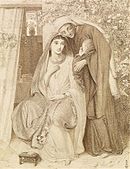
Ruth honoured her widowed mother-in-law Naomi. Simeon Solomon, 1860.
In the gospels, Jesus affirmed the importance of honouring one's male parent and mother (Matthew 15:1–nine, Matthew 19:17–19, Marker 10:17–xix, Luke eighteen:xviii–21) Paul quotes the commandment in his letter to the church in Ephesus:
Children, obey your parents in the Lord, for this is correct. "Honour your male parent and mother" (this is the kickoff commandment with a promise), "that it may get well with you and that you may alive long in the state." (Ephesians 6:1–ii, ESV. See as well Colossians 3:20)
—Ephesians 6:ane–2 (ESV)
In his messages to the Romans and Timothy, Paul describes disobedience to parents as a serious sin (Romans one:29–31, 2 Timothy 3:2).
The words of Jesus and the pedagogy of Paul indicate that adult children remain obligated to honor their parents past providing for material needs. In the gospels, Jesus is portrayed as angry with some people who avoided materially providing for their parents by claiming the money they would have used was given to God (Matthew xv:iii–viii, Mark 7:ix–12. In these passages, Jesus quotes Isaiah 29:xiii) According to the Gospel of John, when Jesus was on the cantankerous, he provided for his female parent, Mary, past giving the Apostle John the charge to intendance for her, which John accustomed.[36]
According to the gospel of Matthew, the obligation to laurels one'southward parents is divisional by one'southward obligation to God: "Whoever loves father or mother more than me is not worthy of me." (Matthew x:37 ESV) Such boundaries, and the primacy of the first commandment itself, pb scholars to conclude that honouring one's parents does not include breaking God'due south law (i.e., committing a sin) at the behest of a parent.[37] [38]
Paul's instructions to Timothy regarding the physical care of widows include the following:
But if a widow has children or grandchildren, these should learn first of all to put their faith into practice past caring for their own family and so repaying their parents and grandparents, for this is pleasing to God.
—1 Timothy five:4 (NIV)
Christian [edit]
Catholicism [edit]
The import of honouring father and mother is based on the divine origin of the parental office:
The divine fatherhood is the source of human fatherhood. (Ephesians 3:14) This is the foundation of the laurels owed to parents. ... Information technology is required by God'south commandment. (Exodus 20:12) Respect for parents (filial piety) derives from gratitude toward those who, by the gift of life, their love and their work, have brought their children into the world and enabled them to grow in stature, wisdom, and grace.[39]
Co-ordinate to the teachings of the Catholic Church building, the commandment to honour father and mother reveals God's desired order of charity – first God, and then parents, so others.[40] Keeping the commandment to accolade begetter and mother brings both spiritual and temporal rewards of peace and prosperity, while failure to honour parents harms the individual as well as social club.[41] The pervasive societal effect of obedience or defiance to this command is attributed to the status of the family as the fundamental building block of gild:
The family unit is the original jail cell of social life. ...Dominance, stability, and a life of relationships within the family unit constitute the foundations for liberty, security, and fraternity within lodge. The family is the community in which, from childhood, one tin learn moral values, begin to accolade God and brand good utilise of freedom. Family life is an initiation into life in lodge.[42]
The Gospel of Luke notes that, as a child, Jesus was obedient to his earthly parents. For a child in the home, the commandment to accolade parents is comprehensive, excluding immoral actions. Grown children, while not obligated to obedience in the aforementioned fashion, should continue to afford respect for parental wishes, advice and educational activity.[43] "Filial respect is shown by true docility and obedience. 'My son, keep your begetter'due south commandment, and forsake not your female parent's instruction. ... When y'all walk, they will pb you lot; when you lie down, they will sentry over you...'" (Proverbs 6:20–22)[44]
The Church teaches that developed children accept a duty to honour their parents by providing "fabric and moral back up in onetime age and in times of disease, loneliness, or distress".[45] This accolade should be based on the son or daughter's gratitude for the life, honey and endeavor given by the parents and motivated past the want to pay them back in some measure.[46]
The principle of the commandment is extended to the duty to honour others indirect authority, such as teachers, and employers. [47] The commandment to honour father and mother also forms a footing for clemency to others when each person is seen, ultimately, as "a son or daughter of the One who wants to be called 'our Father'."[48] Thus, charitable actions are viewed equally extensions of the honour owed to the heavenly Father.
Orthodox Church [edit]
Begetter Seraphim Stephens sees "Honor" defined as "Love and Respect", and notes that this commandment is positioned between those that address i'south obligations to God and those that chronicle to how one treats others. "It conspicuously lays the foundation of our relationship to God and to all other people."[49] Richard D. Andrews points out that, "Every fourth dimension nosotros practice something expert, merely, pure, holy, we bring accolade to our parents."[fifty]
Protestantism [edit]
John Calvin describes the sacred origin of the role of the human father (which thus demands honour). The analogy between the honor of parents and the honour of God himself is farther strengthened by this understanding that earthly fatherhood is derived from God's Fatherhood. Thus the duty to honour does not depend on whether the parent is specially worthy. However, Calvin acknowledges that some fathers are outright wicked and emphasizes there is no excuse for sin in the name of honouring a parent, calling the notion "absurd".[51]
Since, therefore, the name of Father is a sacred ane, and is transferred to men past the peculiar goodness of God, the dishonouring of parents redounds to the dishonour of God Himself, nor can anyone despise his father without existence guilty of an offence against God, (sacrilegious.) If whatsoever should object that there are many ungodly and wicked fathers whom their children cannot regard with honour without destroying the distinction between good and evil, the reply is piece of cake, that the perpetual law of nature is not subverted by the sins of men; and therefore, withal unworthy of honour a father perhaps, that he still retains, inasmuch every bit he is a father, his right over his children, provided it does not in anywise derogating from the judgement of God; for information technology is besides absurd to think of absolving under whatsoever pretext the sins which are condemned by His Constabulary; nay, it would be a base profanation to misuse the proper name of father for the covering of sins.[52]
—John Calvin, Commentary on Exodus 20:12 and Deuteronomy 5:xvi
The commentary of John Wesley on the commandment to honour father and mother is consistent with the interpretation in the Canon of the Catholic Church. He summarizes the actions that limited honour as follows: 1. In esteem of them, outwardly expressed 2. Obedience to their lawful commands (Ephesians 6:1–iii), 3. Submission to their rebukes, instructions and corrections, 4. Acting with consideration of parental communication, direction and consent, 5. Giving comfort and providing for the physical needs of aged parents.[53] [54] Like the Catechism, Wesley likewise teaches that the commandment includes honouring others in legitimate secular authority. He also encourages people toward honour of those in spiritual leadership with the question, "Have ye all obeyed them that spotter over your souls, and esteemed them highly in love for their work'due south sake?" This question is reminiscent of Paul's statements to the church building in Galatia and to Timothy.[55]
Matthew Henry explains that the commandment to honour father and mother applies not simply to biological parents but also to those who fulfil the role of mother or father. He uses the example of Esther honouring her guardian and cousin Mordecai:
Mordecai being Esther'southward guardian or pro-parent, we are told ... How respectful she was to him. Though in relation she was his equal, yet, being in age and dependence his junior, she honoured him as her father—did his commandment, v. 20. This is an example to orphans; if they fall into the hands of those who love them and take care of them, allow them make suitable returns of duty and amore. The less obliged their guardians were in duty to provide for them the more obliged they are in gratitude to honour and obey their guardians.[56]
—Matthew Henry, Commentary on Esther 2
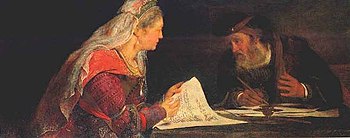
Esther and Mordecai writing the second letter of Purim. Arent de Gelder, ca. 1685. Oil on canvass, RISD Museum of Fine art, Providence RI
The commandment itself encourages obedience "so that you may enjoy long life and that it may go well with you".[57] Henry, Wesley and Calvin assert the applicability of this promise for all who keep the commandment, though each notes that for the New Testament Christian, the promise may exist fulfilled as earthly rewards and/or heavenly rewards, as God sees fit in his wisdom and love for the private.
In his commentary, Calvin notes the harsh consequences required in Exodus and Leviticus for specific failures to go along the commandment. Those who struck or cursed a parent were to exist sentenced to expiry.[58] Persistently disobedient sons were to be brought before the urban center elders and stoned by the whole community if the parents' testimony was judged to be accurate.[59] Calvin writes that God knew death penalty for these offences would seem harsh and be difficult to pronounce, even for those responsible for adjudicating the situation. This is why, he argues, the text specifically places responsibility for the consequences on the offender. The severity of the sentence emphasized the importance of removing such behaviour from the customs and deterring others who might imitate information technology.[60]
Although Calvin refers by and large to fathers in his commentary on the commandment to award father and mother, he writes almost the beginning that the commandment mentions both parents on purpose.[52] As described above, Proverbs supports the value of guidance from both father and mother,[61] and Paul specified that children should provide for their own widowed mothers and grandmothers, "which is pleasing to God".[62]
Merely equally "honour" involves offering profound respect, the opposite of honouring someone is to trivialize him, as if of no importance.[36]
Respect is not something based solely on personal or professional person qualifications, just also on the position that God has given that person. In ane Samuel 26 David spares Saul's life, even at the risk of losing his own, submitting to the authority God had placed over him as all-powerful male monarch.[36]
Rewards for compliance [edit]
This commandment is singled-out from the others in that a hope is attached to it: "...so that you may live long in the land the Lord your God is giving you."[63] Deuteronomy v:16 amplifies this: "...that your days may be prolonged, and that it may exist well with you, in the state which the Lord your God is giving you." [64]
Consequences of defiance [edit]
As with well-nigh terms of the covenant betwixt God and Israel, there are consequences for disobedience as well every bit rewards for obedience:
Just every bit the reward for honouring male parent and mother is very great, the penalisation for transgressing it is very great. And the one who afflicts his parents causes the shechinah [presence of God] to separate from him and harsh decrees fall upon him and he is given many sufferings. And even if life smiles on him in this life, he will surely exist punished in the World to Come.
—Kitzur Shulchan Aruch 143:4
Run into as well [edit]
- Biblical police force in Christianity
- Filial piety
- Pietas
References [edit]
- ^ ''Ten Commandments,'' New Bible Dictionary, Second Edition, Tyndale House, 1982 pp. 1174–1175
- ^ Posner, Richard A., How Judges Think, Harvard University Press, 2008, p. 322
- ^ Bromiley, Geoffrey W., The International Standard Bible Encyclopedia, 1988, p. 117
- ^ Williams, J. Rodman. Renewal theology: systematic theology from a charismatic perspective, 1996 p. 240
- ^ Jersild, Paul T., Making moral decisions: a Christian arroyo to personal and social ideals, 1991, p. 24
- ^ Catechism of the Cosmic Church, §2056, 2003, Doubleday Faith, ISBN 0-385-50819-0
- ^ Matthew Henry'south Curtailed Commentary on Exodus xx:12 read online and on Ephesians 6:1–4 read online (both accessed 31 Baronial 2009).
- ^ a b Commentary on Exodus 20:12, The Jewish Study Bible: Tanakh Translation, Berlin, Adele; Brettler, Marc Zvi, and Fishbane, Michael, eds. Oxford University Press. 2004 ISBN 0-19-529751-2.
- ^ a b See also Deuteronomy vi:iii–4
- ^ a b Exodus 21:fifteen,17, Leviticus 20:9. See also Deuteronomy 27:16 and Proverbs xx:xx.
- ^ Mishneh Torah, Shoftim, Mamrim 6:ane
- ^ a b Kitzor Shulchan Aruch Yoreh Deah 143:1
- ^ Ginzberg, Louis (1909). The Legends of the Jews Vol III : The Other Commandments Revealed On Sinai (Translated by Henrietta Szold) Philadelphia: Jewish Publication Lodge.
- ^ Talmud Kiddushin 31
- ^ (encounter also Kitzur Shulchan Aruch 143:1 and Sefer Maalot ha Middot)
- ^ Mishneh Torah, Shoftim, Mamrim 6:17
- ^ Kitzor Shulchan Aruch Yoreh Deah 143:19
- ^ Plaut, Westward. Gunther and Stein, David E. The Torah: A Modern Commentary (p. 504) 2005 (revised). Union for Reformed Judaism ISBN 0-8074-0883-2 view on Google Books
- ^ Rossel, Seymour. The Torah: Portion by Portion (p. 298) 2007. Torah Aura Productions. ISBN 1-891662-94-5 view on Google Books
- ^ Isaacs, Ronald H. The Jewish Volume of Etiquette (p. 133) 1998. Jason Aronson. ISBN 0-7657-5995-0 view on Google Books
- ^ Exodus 21:xi; Deuteronomy 5:sixteen; Leviticus 19:3;
- ^ Deuteronomy 21:eighteen–21. Note that the reference to the son beingness a drunkard would suggest that he is non a modest child.
- ^ Commentary on Exodus 20:12, The Jewish Report Bible: Tanakh Translation
- ^ Jeremiah 31:9
- ^ Isaiah 43:6
- ^ Malachi 1:half dozen (NIV)
- ^ This family is first introduced in 2 Kings 10:xv–31
- ^ Mishneh Torah, Shoftim, Mamrim half-dozen:2
- ^ Shulchan Aruch Yoreh Deah 240:14
- ^ Isaacs, The Jewish Volume of Etiquette (p. 132)
- ^ Donin, Hayim Halevy. To exist a Jew: A Guide to Jewish Observance in Contemporary Life. (p. 129) 1991 Basic Books. ISBN 0-465-08632-2 view on Google Books
- ^ Sefer Chassidim 542 in Finkel, Avraham Yaakov. 1997 Sefer Chasidim: The Volume of the Pious Jason Aaronson ISBN ane-56821-920-2
- ^ a b Donin, p. 129. sfn error: no target: CITEREFDonin,_p._129 (help)
- ^ Isaacs, pp. 134–135. sfn mistake: no target: CITEREFIsaacs,_pp._134–135 (assist)
- ^ The Footling Midrash Says, Volume 3, The Book of Vayikra, by M. Weissman, C 1988, folio 165
- ^ a b c "Honor your father and mother", The Ethics and Religious Liberty Commission of the Southern Baptist Convention
- ^ Matthew Henry's Concise Commentary on Exodus 20:12–17 read online (accessed 31 August 2009)
- ^ NIV Study Bible. 1999. Zondervan. Notation on Colossians 3:20 with reference to Acts 5:29
- ^ CCC §§2214–2215. sfn error: no target: CITEREFCCC_§§2214–2215 (help)
- ^ CCC §2197. sfn error: no target: CITEREFCCC_§2197 (aid)
- ^ CCC §2200. sfn error: no target: CITEREFCCC_§2200 (help)
- ^ CCC §2207. sfn error: no target: CITEREFCCC_§2207 (help)
- ^ CCC §2217. sfn fault: no target: CITEREFCCC_§2217 (help)
- ^ CCC §2216. sfn fault: no target: CITEREFCCC_§2216 (help)
- ^ CCC §2218. sfn error: no target: CITEREFCCC_§2218 (help)
- ^ CCC §2215. sfn error: no target: CITEREFCCC_§2215 (help)
- ^ CCC §2199. sfn fault: no target: CITEREFCCC_§2199 (assist)
- ^ CCC §2212. sfn fault: no target: CITEREFCCC_§2212 (help)
- ^ "Stephens, Seraphim. "Honor thy Begetter and thy Female parent", Orthodox America, 1996". Archived from the original on 18 January 2017. Retrieved 21 Apr 2016.
- ^ Andrews, Richard Demetrius. "Accolade thy Father and Female parent", Orthodoxy Today, June 2, 2007
- ^ Calvin, John. Harmony of the Law, Part III, Commentary on Exodus 20:12 and Deuteronomy five:16 read online
- ^ a b Calvin, John. Harmony of the Law, Part Iii. Commentary on Exodus 20:12 and Deuteronomy five:xvi read online
- ^ Wesley, John. Notes on the Bible: Notes on the Second Volume of Moses, commentary on Exodus 20:12 read online
- ^ meet as well Matthew Henry's Commentary on the Whole Bible, comments on Exodus twenty:12 read online
- ^ Galatians 6:half dozen and 1 Timothy 5:17–18
- ^ Matthew Henry's Commentary on Esther Chapter 2 read online
- ^ Deuteronomy 5:16
- ^ Exodus 21:xv,17 and Leviticus 20:ix
- ^ Deuteronomy 21:eighteen–21
- ^ Calvin, John. Harmony of the Constabulary, Part Three. Commentary on Exodus 21:15, 17 and Leviticus 20:ix read online
- ^ Proverbs 6:xx–22
- ^ 1 Timothy five:iv
- ^ Plaut and Stein, The Torah: A Modern Commentary(p. 504)
- ^ Kioulachoglou, Anastasios. "Honor your father and mother", Periodical of Bible Accurateness
Further reading [edit]
- U.S. Cosmic Church building. Catechism of the Catholic Church building, 2003, Doubleday Religion, ISBN 0-385-50819-0 (accessed 1 September 2009)
External links [edit]
- A compilation of Jewish theology regarding the commandment to laurels father and mother
Source: https://en.wikipedia.org/wiki/Honour_thy_father_and_thy_mother
0 Response to "what it means to honor your mother and fasther from a jewish perspective"
Post a Comment